Special projects
History of Dallas area Microwave Activity
The following contribution is from Ben Lowe K4QF (November 2, 2025)
Thanks for the report about all of the excellent work on the microwave bands this past Sat., and congratulations to the VUCC achievers. I’m going to forward your email report to all on the Dixieland Gheezers.io group as an example of the good work going on in N.E. TX. To say the least, my old compadre on the VHF/UHF/Microwave bands, Leroy W5HN/W5AJG would be very pleased. As far as I know, when I lived in that area, there was no activity above 2.3 GHz. A few months ago Kent, WA5VJB, mentioned something about some 10 GHz activity using gunplexers, but I don’t know what year this was and I don’t think it was much beyond trying to work across the parking lot or a block down the street. Perhaps Kent can jump in and fill in the blanks. It was 1972 when Leroy and myself had our QSO’s on 2304, and that was over an 8 mile path between my house in Garland and where he lived down next to White Rock Lake about a mile South of Flagpole Hill. Leroy had 5 watts from an 1800 MHz oil well telemetry transmitter where he had shimmed the cavity up to 2304 MHz, and I had a x16 step recovery diode multiplier that produced 100 milliwatts after passing through an interdigital filter I built from Matthaei, Jones, and Young. Our first operation took place from Flagpole Hill to his house as he told me about A.C. power available at a pavilion on Flag Pole Hill to power my rig.
If the NTMS hasn’t already done so, it’s probably time to record the history of V/UHF Microwave activity in the N.E. TX area before the cooperate memory is lost. So, here’s my contribution. Most of what follows is information I got from Leroy about early ham radio activity in the Dallas area. Leroy got his ham license in 1923 at the age of 15. He said there were three teenage hams in the Dallas area at the time, and there was one high school, Dallas High. Because of the expense of equipment at the time and the current state of the technology, he said each of them built their own transmitter, but they had to pool their money to buy a tube. The inductors at the time were made by gluing 6 or 8 popcycle sticks vertically to a wooden base and interweaving an inductor between the popcycle sticks. The arrangement they worked out was that they would bring the tube to school in their lunch buckets and swap it between them. One of them went to his grandparents in Denton every weekend, so that left the other two to swap having the tube every other weekend. With 5 days left in the week, the kid that went to Denton got the tube for 3 days of weekdays, and the other two had it for 1 day of the remaining weekdays. Around 1975, I read in the QST column about “50 years ago this month” about Dr. A. Hoyt Taylor of the Naval Research Lab in Washington conducting an experiment to test the feasibility of air to ground communications by placing a transmitter/receiver on a blimp and flying it from Washington to Los Angeles. The blimp had an antenna hanging vertically below the blimp, and he ask hams along the way to try to contact the blimp using their ham equipment. I ask Leroy if he remembered when that happened, and Leroy said he actually worked the blimp as it passed over Dallas because it was his day to have the tube! What luck.
Leroy had a 5 meter (56 MHz) WAS award and then a 6 meter WAS when the band was shifted down to 50 MHz. The 5 meter band was the 2nd harmonic of 28 MHz, so that was convenient for multiplying a 10 meter signal to 5 meters. When TV came into being, the 5 m. band was shifted to 6 m., 50-54 MHz, and squeezed in between channel 2 and channel 1 which was 44 to 50 MHz. The channel 1 spectrum was used for two-way public service, and I don’t think channel 1 was ever activated by a television station. None the less, Leroy had to rework all 48 states for a 6 m. WAS and then later work Hawaii and Alaska for his 50 state WAS on 6 m.
Shortly after WW II, military surplus equipment became available to hams at very cheap prices. My first ham transmitter was a BC-459 for 40 m. and cost $8 from Fair Radio Sales. To modify the equipment for ham use, a book was available entitled “The Command Set Conversion Handbook.” Leroy had an article in this book for converting a piece of surplus equipment to 1296 MHz, and this was what all of the DFW stations were using when I got to Dallas in 1966. I believe it was someone else that wrote an article for modifying some piece of equipment for a 1296 amplifier. As I recall, it had a ring of 2C39 tubes and ran a couple of hundred watts of input power. I remember Leroy having some 300 watts (input) on 432 and a 75 ft. windmill tower in his back yard with a 5 ft. diameter dish on the tower for 1296. Another ham in the Houston area, Chick W5LDV, ran 500 watts on 432 with a single yagi, and he and Leroy ran a sked every morning over that 235 mile path. Signal were normally about 5 x 5 on SSB, but if conditions were enhanced, S9+, Leroy and Chick would QSY to 1296. I believe WA5VJB took down this tower and antenna after Leroy became a silent key.
Other stations I recall being on 1296 were Vic (can’t remember his call) who lived in a suburb on the N.E. side of Ft. Worth and I think a station in Gainesville; I want to say K5PUF(?). Bill, W5GVE in Waco, was 120 miles to my South was on 432 MHz, and he was about the limit of my 20 watt signal to a signal yagi from my Garland QTH. I could normally work K5JL, Jay in Oklahoma City, on 432 about 200 miles to the North, and his 2 or 3 KW was no problem for me to copy. Of course, during a good band opening, and I mean really good, I could work 1,000 miles across the Gulf into Florida.
That was the state of very high frequency operation in N.E. TX when I left there in the Fall of 1973. Kent may have some additional information about the time frame before that, so he should chime in. Around 1971 or 1972, a “younger” guy showed up in the next lab over where I worked for T.I. in the Missiles and Ordinate Div., and this was WA5LUA, now of course, W5LUA. He would come out in the hall way at coffee break and talk about how he was going to get on EME. Did he ever!!!
73’s…Ben/K4QF
The following contribution is from Kent Britain WA5VJB (November 3, 2025)
Hi Ben
You were thinking of Vick Vick Vicksell W5HPT on that hill just North of Ft Worth.
He was big on ATV with the cameras were nearly the size of a washing machine!
He and Leroy would get on 432 most mornings with Chic down in Houston and if
conditions were good, QSY to 1296. Visited Chic in 1981. For a NASA engineer
he sure liked to do things very very basic. I remember 2C39's suspended in mid air
by the wires. Home made plywood dish with a handle near the ground. Would
connect up an external speaker to his command set IF, run out in the back yard,
and hand peak the dish on their signal.
i remember Leroy's 2.3 GHz station. Not much gain in his highly modified oil pipline
microwave links. As I recall he had 3, maybe 4 in a row to get that multiplier up to 5 watts.
As I recall, he was very close to WAS on 5 meters before the war shut down the band, but never actually got all 48. It took a 'DX Pedition' to the Texas Arkansas border to get Leroy his 48'th on 6 Meters. Summer 1950. Arkansas was one of my last ones on my 6M WAS. Long Haul for Tropo, Kind of short for E.
He also told the story of being the last station in Dallas on Spark. As he told the story he came out of High School and half of the hams in Dallas were waiting for him. They had collectively gotten him all the pieces to build a CW station and get him off spark! I have his 'Spark' key somewhere out in the back garage. With spark if you ran 1 KW, then you had 1 KW passing though the key. A lot of volts, a lot of amps! A proper spark key cost what most people earned in a month. Leroy used a 'Dime Key'. You took a telegraph key and soldered two silver dimes to become the high power contacts.
Always amazed how he was able to use that Sam Harris Para-Amp on 1296. Al and I made Leroy several GaAs FET preamps that should have had a better NF than that Para-Amp, but he always went back to the Para-Amp. After he passed away I had it on my work bench and understood. It was made for 1100 MHz FAA use and was really on the edge of it's bandwidth at 1296.. But as a regenerative amp the Q was off the chart. Tweaked up on 1296 it was only about 4 MHz wide. All his images just went away.
As a technical note. A Para-Amp gets 25-30 dB of gain out of a Varactor Diode! You have two cavities.
In this case one cavity is tuned to 1296, the 2nd to 10 GHz. Where the 2 cavities come together mount a varactor diode. With a klystron in this case, put energy into the 10 GHz cavity. Signals in the 1296 cavity take that energy and are amplified. A bit tricky. A connector into that 1296 MHz cavity is both the preamp input and the preamp output! Yes, the same connector is in and out. A circulator is highly recommended.
WB5CHW and I got on 10 GHz FM with Gunnplexers in 1980. Earliest 10 GHz activity I know of in the Dallas area. KF5N, WA5DBY, and myself all got on SSB in 85 I believe. In 81 we had a 10 GHz FM beacon on the library building at UTA for a short time. GaAs FET DRO for the transmitter. Harold, K5SXK made the slot antenna I still use when 10 GHz Mobile. Looking forward to BBQ tomorrow. 73 Kent WA5VJB
The following contribution is from Ben Lowe K4QF (November 3, 2025)
Kent,
You are correct in that it was Vick, W5HPT. In the 1972/3 time frame, Vick was on but didn’t get on the normal QSO sked Leroy had with Chick in Houston. Their sked was at 7:30 a.m., so I’d listen in on the sked to see if conditions were sufficient to support my 20 watts reaching Chick in Houston. If not, I’d hop on my bicycle and head for work at T.I. which was a 6 mile trip. With the bike, I could park at the bike rack by the front door and be at my desk by 8 o’clock.
One morning when conditions were enhanced, Leroy and Chick went to 1296, but I could still here Chick’s 432 MHz signal although it was weak. Later that day, I phone Leroy and ask how I was hearing Chick’s CW signal when they went to 1296. Leroy contacted Chick and learned that when Chick went to 1296, he switched his 432 driver from the linear amplifier input on 432 to the tripler input to get 1296. However, the 432 amplifier still had B+ and would still amplify the 432 MHz leakage through the changeover switch. Chick measured the 432 MHz amplifier output when he was switched to 1296, and it was 70 milliwatts! That wasn’t too bad for the 235 mile path.
As for the Sam Harris parametric amplifier, Sam was the dinner speaker at the Central States VHF Conf. that was held at the lodge at the Lake of the Ozarks State Park in Arkansas. Later that evening I was showing Sam my slides I had made when I visited Ray, VK3ATN, in Australia. Ray had worked Sam at Arecibo on 2 m. EME with Ray running 150 watts to four stacked Rhombics that were 50 wavelengths on each leg. After my showing, Sam invited me to come to Arecibo for a visit which I gladly accepted. A few months later, I loaded up with my wife, and we went to Puerto Rico. Sam said we could sleep on the water bed in his garage, but that was where his two German Shepherds normally slept. He said if the dogs, named Moon and Bounce, tried to get in bed with us, just shew them away. All of the Puerto Ricans had bars on the doors and windows to cut down on theft, but Sam hadn’t completed his house to the point that he had any doors or windows. But, with his two dogs, he never had anything stolen. For the two days we were there, I got an intensive short course on EME plus a grand tour of the 1,000 ft. dish setup.
Sam also told about developing the parametric amplifier while he was at Microwave Associates. He said they worked great when they worked, but they were touchy to make work and it was difficult to tell when it was working and when it was not. He had built a 2nd para-amp for 1296 and sent it to California to the Eitel-McCullough group. They in turn sent Sam a high power amplifier for 1296, and those two stations were used for the initial ham radio moonbounce contact.
I believe it was 1973 that the CSVHF Conf. was held in the DFW area, and while there I ran into Al Burson, later to become K5EE. Al’s friend, Carl Scheideler W2AZL, was there and staying with Al, so Al introduced him and “the guy that had published the low noise, 2 meter converter that was in the QST that had about a 2 dB noise figure. Carl was part of the W2CXY basement engineers from Bell Labs which included K2TKN, K2GQI, W2HAC, and others. When Carl mentioned his low noise figures, I told him I had a 2 m. preamp design with a 1.5 dB or less NF. A friend who worked in T.I Semiconductors had given me a hand full of 2N4416 FET’s, and every one I tested had less than a 1.5 dB noise figure. Carl wanted to see it, so the next day when I went to the conference, I showed it to Carl. Today if you’re not down around 0.25 dB NF, you’re not in the game! And, there’s nothing tricky like there was with the parametric amplifier.
As for working Arkansas, it has always been an RF vacuum for VHF, UHF and microwaved. Thankfully, now we have Pat, W5VY, there, and sometimes Steve, AG4V from Memphis, ventures over to the state. I made my DX-pedition to Rich Mtn. in 1972 to give all of the TX stations AR on 432 MHz.
Ben/K4QF
The following contribution is from Rick Hall K5GZR (November 3, 2025)
Ben,
Don’t know how to post the image to the reflector, but maybe it will get to you direct.
If someone can tell me how to get the image to the group I will do that.
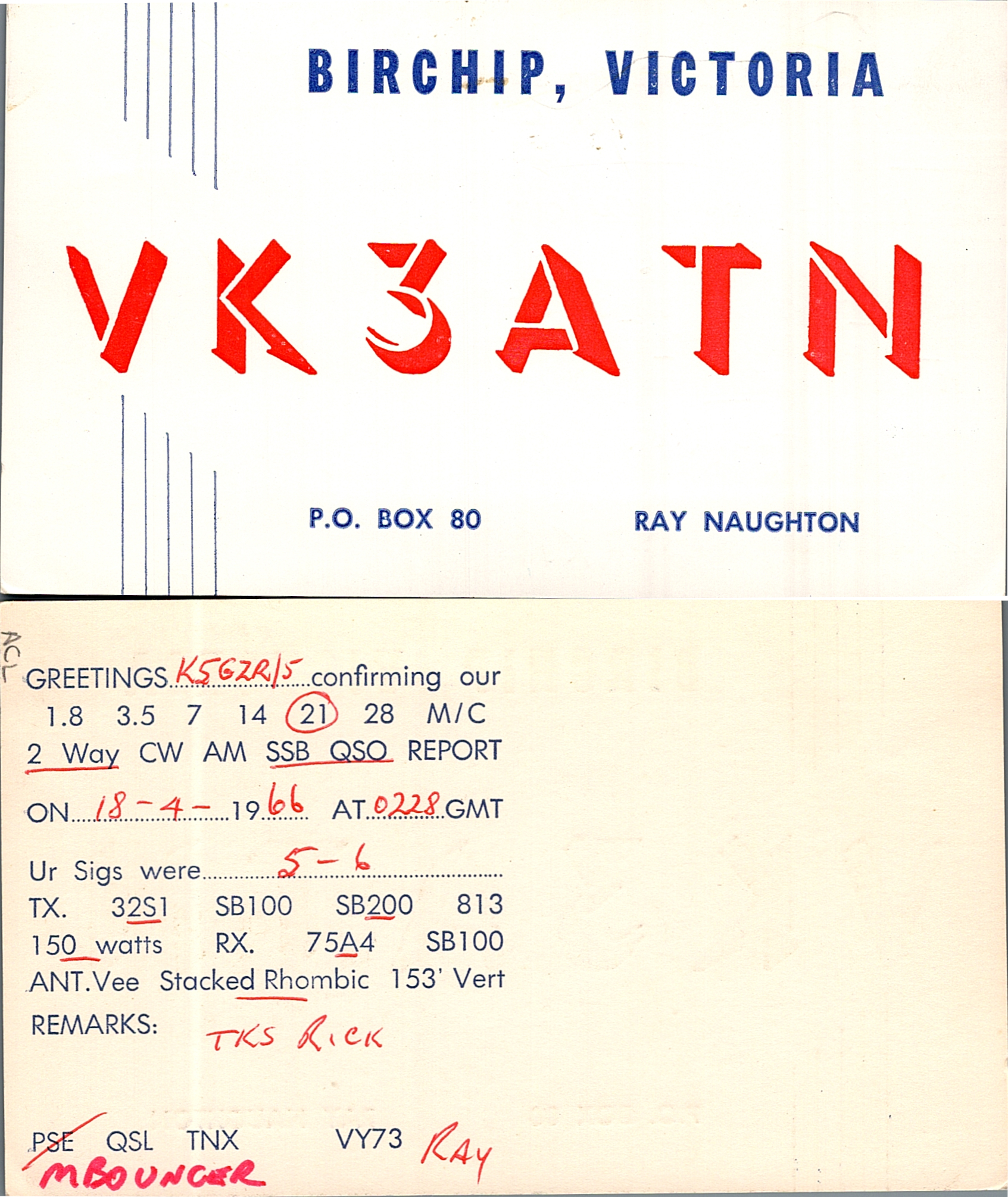
In any case, the attached file is a scan of a QSL card from Ray to confirm our 15 meter SSB QSO from April of 1966 – while I was operating portable at Austin College in Sherman, TX.
Rick
The following contribution is from Kent Britain WA5VJB (November 3, 2025)
Hi Ben
Twice I have taken an Para Amp to a NF contest. Yes, they can be very tricky to tune up.
EVERYHTING interacts.
But the Sam Harris one that Leroy had contained 2 Ferrite Isolators and 2 Ferrite Circulators.
Tuned up very smoothly.
That Leroy every got it working on 1296 was a tribute to his tweaking skill.
I played with it using a Sig Gen for the Pump rather than the Klystron and a Network analyzer
looking at gain and bandwidth. At 1.1 GHz you could dump most any XBand RF in the pump and
it worked. As you went up, it got very fussy. At 1.29 GHz the pump had to be in a 50 MHz range near 11.5 GHz and the power only had about 4 dB range before it quit.
I also got to play with the Para-Amp used in the first 2304 MHz EME QSO. Al, what was his call? W3GKP?
It was the one that was listening to W4HHK's signal. Got part of the Pump assembly from Paul's Para Amp.
Also in my collection is the 5.8 GHz GaAs FET preamp from the first 6 cm EME QSO and of course the GaAs FET preamp from the first 10 GHz EME QSO.
Kent WA5VJB
The following contribution is from Ben Lowe K4QF (November 3, 2025)
You have Smithie’s call correct when he was at NASA Goddard, but when he retired he moved to the mountains of North Carolina, not all that far from where I am now, and changed his call to K4RF. He would meet Paul on 75 meters down in the Extra Class part of the band, and I’d sometimes join in with them.
I once went to the Central States VHF Conf. in Memphis, and Paul invited everyone interested to come to his house on Sunday after the conference ended. He had some recording he had made of the astronauts on the moon using their S-band transceiver to communicate with Earth. Paul used his 18 ft. dish to down convert to VHF and used a GE Progress Line FM receiver to demodulate the signal from the moon. To say the least, they had a very strong signal, not at all like moonbounce.
You just never know who you’ll run in to in Huntsville. A ham friend once called and wanted to know if I could join “them” for lunch. When I got there, the other guy was named Ron Perez, and he was also a ham and an astronaut who had recently returned from space. I also met Francis Gary Power’s son who was in town to pick up an SA-2 air defense missile, the missile as the kind that was used to shoot down his father’s U-2. He was taking the missile to his Cold War Museum in Springfield, VA.
Huntsville also has the Space and Missile Defense Command, the Missile Defense Agency, NASA’s Marshall Space Flight Center, the Aviation & Missile Command and now the FBI research lab with some 4,000 people. Coming soon is the Air Force Space Command. You would think with all of the technology here there would be much more emphasis on the microwave bands by the hams, but I was surprised at the lack of activity when I got here. In the Dallas area, I’d turn on my 2 m. FM radio, and the hams were always talking about designing this or that. In Huntsville, they were always talking about having to mow the grass at their lake house, maintain their boat, or their golf game, and the big gun hams were chasing DX. I think the Aerospace/Electronics companies in DFW fostered more interest in getting developing technical skills; i.e. people who designed things on the job. Another big difference I noticed was how much people in Huntsville traveled the world for business and pleasure. When we stopped in Tahiti last Jan. on our way back from New Zealand, that made the 38th country I’ve been to. I think my 100K mile warranty ran out long ago!
When Leroy got his 2304 mixer tested, he wanted me to tune up his L.O. He had a diode multiplier driving another diode multiplier. I got it running, and the mixer seemed to work o.k. for his receiver. That was before low noise transistors were readily available for that frequency. Leroy had a signal generator he had gotten from Thunderbird Surplus in Ft. Worth (you probably knew them), but he couldn’t get the output from the generator low enough to determine the sensitivity of the receiver. I think the signal generator had a BWO that was leaking around the variable attenuator. So, Leroy carried the signal generator about 50 ft. out in his back yard and ran a piece of coax from the output to his shack. To negate the BWO leakage, he put a wash tub over the signal generator; not exactly a screen room but good enough for his purpose.
Ben/K4QF
The following contribution is from Ben Lowe K4QF (November 3, 2025)
Rick,
You worked Ray in 1966, and that was 5 years before I visited him in 1971. He became a very good friend over the years, and still to this day we exchange Christmas cards every year with his XYL Margaret.
When Ray built his stacked Rhombics for 144 MHz moonbounce, the end to end length of the antenna was about 750 ft. Where he lived in Birchip, the terrain was a flat as a pancake, and the main “industries” were raising sheep and growing wheat. Ray didn’t have enough land, so the city of Birchip let him run the Rhombics across the road near his house and into the vacant field which was unoccupied. As long as the Rhombics cleared the road by 25 ft., the town didn’t care.
Ray ran a hardware store, so he had access to plenty of electric fence wire to construct his Rhombics. HOA was an unknown term where he lived.
I have some familiarity with Sherman. My wife grew up in Denison.
73’s…Ben/K4QF
The following contribution is from Kent Britain WA5VJB (November 3, 2025)
Ahhhh Thunderbird. In North Fort Worth off N27th
Spend all my piggy bank to buy a HP 8-12 GHz wave meter so
I could find what frequency my Gunns and Klystrons were really on.
I also remember the BIG pile of ART-13s. Quite the HF AM rig.
Not sure exactly when they closed. About 1970 or 71. Kent
|